Wednesday, September 19, 2018

Ashtadik palas.......The Gods of 8 Directions......

My Dear Friends............Good Evening...........&..............
Please read and be aware of many things in the topic Ashtadik palas.......The Gods of 8 Directions......
The Ashtadikpālas are eight in number. As their collective name suggests, they rule the eight quarters or the eight directions of the universe. Ashta means eight, “dik” means quarters or directions and” pālas “means rulers. According to Hinduism each quarter is assigned to a particular divinity, who presides over it and acts as its chief guardian spirit ensuring the orderliness  of the universe and the protection of its occupants(It is interesting to note that there are no goddesses in this list, just as there are none in the list of navagrahas also). Symbolically the eight rules of directions are represented as eight elephants standing in eight directions.
The concept of Ashtadikpālas was a post vedic development. In the Vedic period it was the Adityas who ruled the skies and kept a watch over the world from one end to another. The Adityas knew all the deeds, because they had eyes and spies everywhere. The Adityas were born out of Aditi, the mother of all Gods. While the Adityas rule the skies, on earth it is Pusan, the handsome God with a shaft who knew the directions and who shows the paths that lead to green pastures and safe places. In the Rigvedic hymns we do not find any reference to the dikpalas. But as individual Gods each of them enjoyed a supreme status and commanded his own following and veneration.
However and but ,in the post Vedic period, fundamental changes took place in the Vedic religion. A new order emerged in the Vedic pantheon. Many Gods lost their ranks while some completely disappeared. Probably the priests or the priestly families who specialized in their worship and invocation of Gods moved elsewhere or turned to new Gods. The Rigvedic Aryans migrated from inhospitable terrains to newer and safer lands with a more dependable climate and more hospitable terrain.The emphasis shifted from politics of isolation to politics of adjustment and compromise with native cultures. With the rise of bhakti cults such as Vaishnavism and Saivism, elaborate rituals yielded place to simple devotion to a personal God.The Vedic Gods lost their significance during this period and reemerged as the dikpālas.
Images of these Gods can be seen in many temples on a central panel in the ceiling of the central pavilion (Māhamandapa) facing the main deity. If the temple is a symbol of God’s abode, its ceiling is the sky. The Ashtadikpālas are rightfully the guardians of the sky, watching over us from eight different directions and keeping an eye on all our activities.
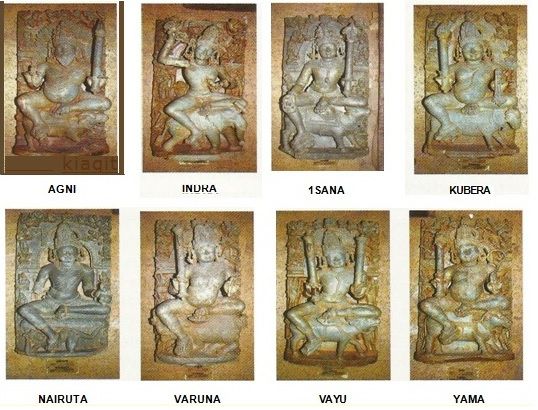
Ashtadikpalakas MantrasAshtadikpalakas – Gods of 8 Directions in Hinduism


The concept of the Ashtadikpālas symbolically denotes on the idea and encouraged the thought (and also ingrains the fear in order to prevent wrong activity), that God is every where and in every direction and that in whatever direction you proceed or offer your worship, you will ultimately find Him. In ancient times, when one had to travel through difficult terrains or dangerous forests, this belief would have been a great comforter. Many people are perhaps not aware that when we make an atma-pradakshina (revolving around one self) in front of God, we are not only saluting the self with in, the God in front, but also the divinities that are around us in all the directions.
The  knowledge of the Ashtadikpālas became the basis for the evolution of the traditional Hindu science of design and construction called Vasthushāstra. Vasthu-shāstra means knowledge of things. It is actually a science which deals with how things should be organized in a particular location for the better flow of energies and blessings of divinities. In ancient India it played an important role in the:-
Construction of temples and places of worship
Location of various components of a house in relation to the street, city or town where it is located,
Location and arrangement of various household things like furniture and utensils and arrangement of rooms, doors and windows with in the house,  location of the farm fields and water tanks, how to position a dead body before and during cremation, the direction in which one should sleep or sit while performing a puja or a ceremony and so on. Vashtushastra might have drawn its contents from various sources, knowledge of ancient mathematics, water divining, knowledge of the human body, construction of the ritual places, designing of yantras and the occult knowledge of sensing the flow of energy and so on.The Knowledge of the directions and its divinities was one of its core elements.
 For example, many traditional Hindus believe that the north east corner of a room should be left vacant, because that direction belongs to Iswara. They would also prefer to do business facing north, because north is ruled by Kubera, the lord of wealth, and avoid facing the south generally, since the direction is ruled by Yama, the lord of death. People also would not prefer to construct their houses, with the main facade facing the south, since that would supposedly lead to physical and mental difficulties and disabilities for the occupants and the owners.
With the increasing pressures on the availability of space, problems of finance and construction, few people are able to comply with the specifications of this ancient science. Many educated Hindus ignore it completely and carry on their businesses as usual. The eight Gods who rule the eight quarters are as follows:-
NameDirection  MantraWeaponConsortGraha(Planet)Guardian Matrika
KuberaNorthOm Sham Kuberaya NamahGada (mace)KuberajayaBudha (Mercury)Kumari
YamaSouthOm Mam Yamaya NamahDanda(staff)YamiMangala (Mars)Varahi
IndraEastOm Lam Indraya NamahVajra (thunderbolt)SaciSurya (Sun)Aindri
VarunaWestOm Vam Varunaya NamahPasa (noose)NalaniSani (Saturn)Varuni
IsanaNortheastOm Ham Isanaya NamahTrisula (trident)ParvatiBrihaspati (Jupiter)Mahesvari
AgniSoutheastOm Ram Agnaye NamahSakti(Spear)SvahaSukra (Venus)Meshavahini
VayuNorthwestOm Yam Vayuve NamahAnkusa (goad)BharatiChandra (Moon)Mrigavahini
Nirrti (sometimes Raksasa)SouthwestOm Ksam Raksasaya NamahKhadga (sword)KhadgiRahu (North Lunar Node)Khadagadharini
J.KANNAN, M.Com, FIATA

"WE DON'T THINK TO BREATHE
 WE BREATHE TO THINK"

Bhojana kramam also known as.................Pariseshanam

Bhojana kramam also known as.................Pariseshanam

Bhojana Kramam, which includes Pariseshanam, Pranahoothi mantras are described .......Below......

Karma:........

After Sandhyavandhanam and Thiruvaradhanam, Bhojana kramam starts.

Bhojanam offered to Lord during Thiruvaradhanam should be had just as it is without any addition / omission.

Short version:

First you address the food “AsmAkam nityam astu Etat”

1. Om Bhurbhuvasuvaha:...... Sarva sAdhArana Prokshana Mantram for purifying the
food

2. Satyam tvA ruthEna ParishinchAmi:...... Here the food is addressed as satyam.
I encircle you with ‘rutham’. These two words are often used in vEdAs. For
eg. Brhma Yagnyam etc., In the evening the address is reversed. I recall
the meaning of rutham as righteousness.

3. amruta upastaranam asi;..... Be a ‘lining’ to the amrutam(i.e. the food)

4. amruta abhidAnam asi:....... Be a ‘lid or cover’ to the amrutam.

Extended Version:..........

1) Wash your feet and palms and perform aachamanam.

2) After the rice and ghee are served, sprinkle little water on the food
while chanting the following mantra, inorder to do nivedhanam to
Bhagawan who resides in you as an antharyAmi.

Om antharyAmiNE nama:

3) In your right palm, have some water, and put it around your leaf(or plate)
in clockwise direction and chant the following mantra.

Om bhurbhuvassuva:

4) Do the following nyasam.

prANAgnihotramanthrasya bhrahmA rushi: (touch top of the head)

anushtup cchandha: (touch the tip of the nose)

vaishvAnarAgnirdevathA (touch the heart)

prANAgnihotrE viniyOgha: (both the palms together do the
semicircular motion starting from outside towards you)

5) In your right palm, have some water, and put it around your leaf(or plate) in

clockwise direction and chant the following mantra.

sathyam thvarthEna parishinchAmi (during the day)...&...

rutham thvA sathyEna parishinchAmi (during the night)

6) Then partially lift the top left corner of the leaf or you could touch the
plate.

Use only the thumb, index finger and middle finger of the left hand. You can
skip this step if perumAL theertham is self-served.

7) Request for the perumAL theertham to be served. First, sprinkle the
theertham...

onto the food. Second, hold the perumal theertham(pAdhyam). Don’t have yet,
wait until the theertham is served for all.

8) Chant the following manthra and then have the theertham without noise.
amruthOpastharaNamasi

9) Then perform the following prANAhoothi. Use only the thumb, index finger
and middle finger of the right hand and take a very little amount of the rice
and ghee mixed and swallow it without touching the teeth.

Om prANAya svAhA (east)
Om apAnAya svAhA (south)
Om vyAnAya svAhA (west)
Om udhAnAya svAhA (north)
Om samAnAya svAhA (center)
Om bhrahmaNE svAhA (center)
Om bhrahmaNi mama AthmamruthathvAya (center)
SriGovindhAya nama:

10) Now, switch the one you are holding with left hand to right hand....&.... Request to serve water to purify your left hand at that corner.

11) Until you come to this point don’t have anything other than what you had
during parisEshanam.

12) Have thrupthi bhOjanam.

13) Have what you need to (food, fruits, water etc) before the utthara bhojanam.

14) utthara bhojanam. Request for the perumAL theertham to be served. Hold the

perumal theertham(pAdhyam). Don’t have yet, wait until the theertham is served
for all.

Chant the following manthra and then have half what was served.
amruthApidhAnamasi

15) And pour the rest around the leaf while chanting the following.

rauravE apuNyanilayE padmarbudha nivAsinAm |
arththinAmudhakam dhaththam akshayyamupathishtathu ||

16) Then, gargle 16 times, wash your feet and perform the Achmanam twice.

Gyana: ( Philosophy )......

There is actually philosophical significance to the parisecana and prANAhuti mantras.

1) Parisecana..............

As has been explained earlier, after we sit down for our meal, we say the mantra:

satyam tvartena parishincAmi....Means.....

(O Food! You are True. I encircle you with divine righteousness.)

and we circumambulate our food with a sprinkling of water......

This sprinkling of water is known as “parisecana”.

At night, this mantra is....... ‘Rtam tvA satyena parishincAmi’,
transposing the ‘Rtam’ and ‘satyam’.

To surmise one meaning from the mantra. “Satya” means that which is real
or true. “Rta” is a notion of the Divine Law or moral principle.The term “Rta” is often found in the Rg Veda, and it is from this that the idea of “dharma” later evolved.

From this we can gather that the parisecana mantra is sort of a formulaic “protection” for the food we are about to eat. Practically, it does also serve to ward off insects, etc.,
and perhaps this is another reason why the ritual developed in this particular form.

2) prANAhuti — the offering to the vital breaths.......

The next step is the part of greater philosophical significance. Recall that in the Vedic tradition, every act eventually becomes an act of worship, an act of recognition of the pervasiveness of the Supreme Brahman and Its power.

When we eat, we nourish our bodies. Food is therefore essential for bodily sustenance. Within our body is the “ana” or vital breath. The “ana” has five activities or “prANa-s”.
The five prANa-s represent the various bodily functions that are critical for survival. They are considered a manifestation of the power of the Supreme in the bodily plane.

It is almost a universal cultural idiom to recognize breath as the vital force behind life. In English, when someone dies they are said to have “breathed their last”. In Tamil,
the word “ushir” or “uyir” can mean both breath or life.

The idea is that by first making an offering to the prANa-s, we pay homage to their life-giving power by virtue of their performing the bodily activities that are crucial to our
survival. In this way, this ritual recognizes that not only is food important to survival, but the very bodily functions that we take for granted are essential, and we owe all of this to the Supreme, who sits as the superintending power behind all bodily activity, no matter how mundane.

The vital breaths or “prANa-s” are five in number. The latter four are derived from the first. They are:

prANa — the principal breath
apAna — responsible for excretory activity
samAna — responsible for digestive activity
vyAna — responsible for circulatory activity
udAna — respiratory activity

This act of thanksgiving to God who through these bodily functions sustains life is done by saying the following mantras, and eating a little bit of rice and ney (ghee)
without chewing it (because, after all, the food is an offering, not meant for personal consumption):

om prANAya svAhA
om apAnAya svAhA
om vyAnAya svAhA
om udAnAya svAhA
om samAnAya svAhA

om brahmaNi ma AtmA-amRtatvAya

The last line means, “May my self be united in Brahman (the Supreme), so that I may attain immortality.”

Eating, then, is a profound act of worship which sustains the body so that we may further worship Brahman. There is also an implication that the swallowing of tasty food symbolizes the oblation of the individual self to God, so that God may,
in a sense “eat” and “enjoy” us.

Before and after eating the meal, water is sipped, once again with a mantra. The rishis of yore found this aspect of the ritual so important that they mention it in both of the largest Upanishads, the Brhadaranyaka and the Chhandogya, in virtually
identical terms:

Realized people, while eating, do as follows: before and after their meal, they “dress up” the prANa with water. The prANa receives clothing in this manner, and
is does not remain naked.

— Chhandogya 5.2.2 & Brhadaranyaka 6.1.15

“clothing the prANa” with water is so important, but both Sankaracharya and
Ramanujacharya write that meditation on prANa having
water as its garments is very important.

It does make some sense, however, from other angles.Water is a purifier, and drinking water before and after (Acamanam) is a purifier and sustainer of the body.Furthermore, the yoga shastras recommend that we eat food to fill only half our stomach; one half of the rest, i.e., one quarter of the stomach we should fill by drinking water. The rest
should be air. This is supposed to be the ideal proportions for spiritual and bodily health...............Thus...........

The mantras recited when sipping water before and after imply this as well:

amRtopastaraNam asi — Oh water! You are the seat
of immortality.

Since water is drunk before and after the food, perhaps this is a suggestion that to approach immortality, one should drink water to fill the stomach 1/4 way.


J.KANNAN, M.Com, FIATA

"WE DON'T THINK TO BREATHE
 WE BREATHE TO THINK"